User Experience in Mental Health Applications
LIS7010 User Interface Design
Overview
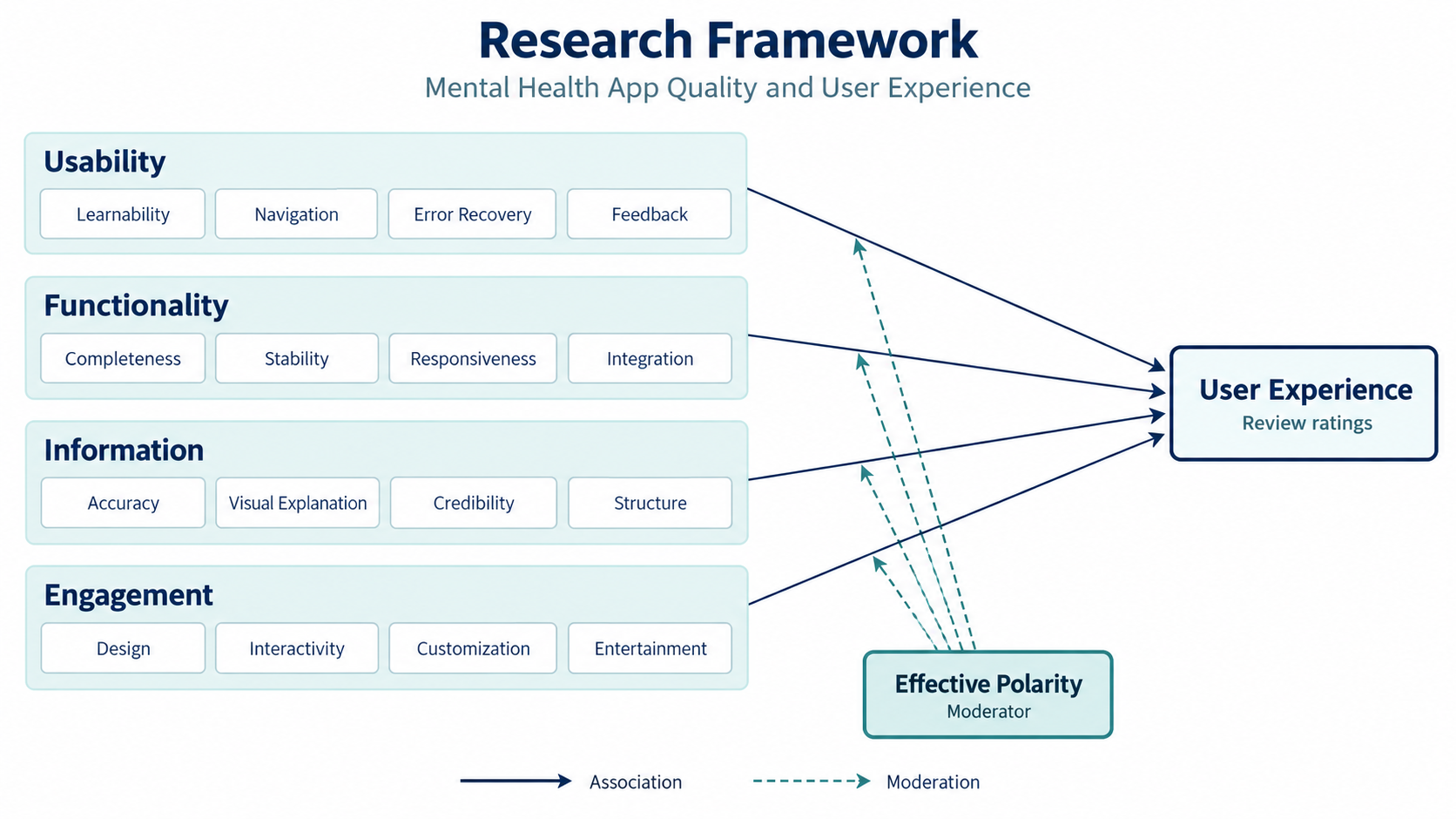
Analyzed 46,216 Google Play Store reviews from six mental health apps to examine how app quality and emotional tone relate to user ratings. Developed a framework of four quality dimensions and sixteen factors based on MARS, MAUQ, PSSUQ, and SUS.
Methods: TF-IDF Keyword Extraction · Quality Factor Labeling · VADER Sentiment Analysis · Linear Regression · Moderation Analysis
Data
The dataset consists of Google Play Store reviews collected from six mental health applications.
| Application | App ID | Number of Reviews |
|---|---|---|
| Voidpet Garden: Mental Health | com.voidpet | 3,210 |
| BetterMe: Mental Health | com.gen.bettermeditation | 4,886 |
| MindDoc: Mental Health Support | de.moodpath.android | 8,120 |
| BetterHelp - Therapy | com.betterhelp | 10,000 |
| Youper: AI Therapy | br.com.youper | 10,000 |
| Wysa: Anxiety, therapy chatbot | bot.touchkin | 10,000 |
App Quality Framework
To construct the app quality framework, this project reviewed four established usability and quality evaluation instruments:
- MARS: Mobile App Rating Scale
- MAUQ: Mobile App Usability Questionnaire
- PSSUQ: Post-Study System Usability Questionnaire
- SUS: System Usability Scale
Based on these instruments, app quality was organized into four higher-level categories and sixteen detailed quality factors.
| Higher-level Quality Factor | Detailed Quality Factors |
|---|---|
| Usability | Learnability, Navigation, Error Recovery, Feedback |
| Functionality | Completeness, Stability, Responsiveness, Integration |
| Information | Accuracy, Visual Explanation, Credibility, Structure |
| Engagement | Design, Interactivity, Customization, Entertainment |
TF-IDF Keyword Extraction
TF-IDF was used to identify important word stems in the review corpus. Words with a maximum TF-IDF value of 0.7 or higher were selected and then mapped to the app quality framework.
Examples of mapped word stems include:
| Quality Factor | Example Word Stems |
|---|---|
| Learnability | easy, learn, quick, simple, understand |
| Navigation | screen, menu, button, access, page |
| Stability | crash, bug, freeze, lag, load |
| Credibility | trust, evidence, expert, source, reliable |
| Entertainment | fun, enjoy, game, interesting, love |
Key Findings
- App quality: Functionality and information mentions were associated with lower ratings, while usability and engagement mentions were associated with higher ratings.
- Specific factors: Navigation and completeness showed the strongest negative associations with ratings, while entertainment and interactivity were positively associated.
- Emotional context: Sentiment moderated the relationship between quality-factor mentions and ratings, with the strongest positive interaction effects for navigation and completeness.
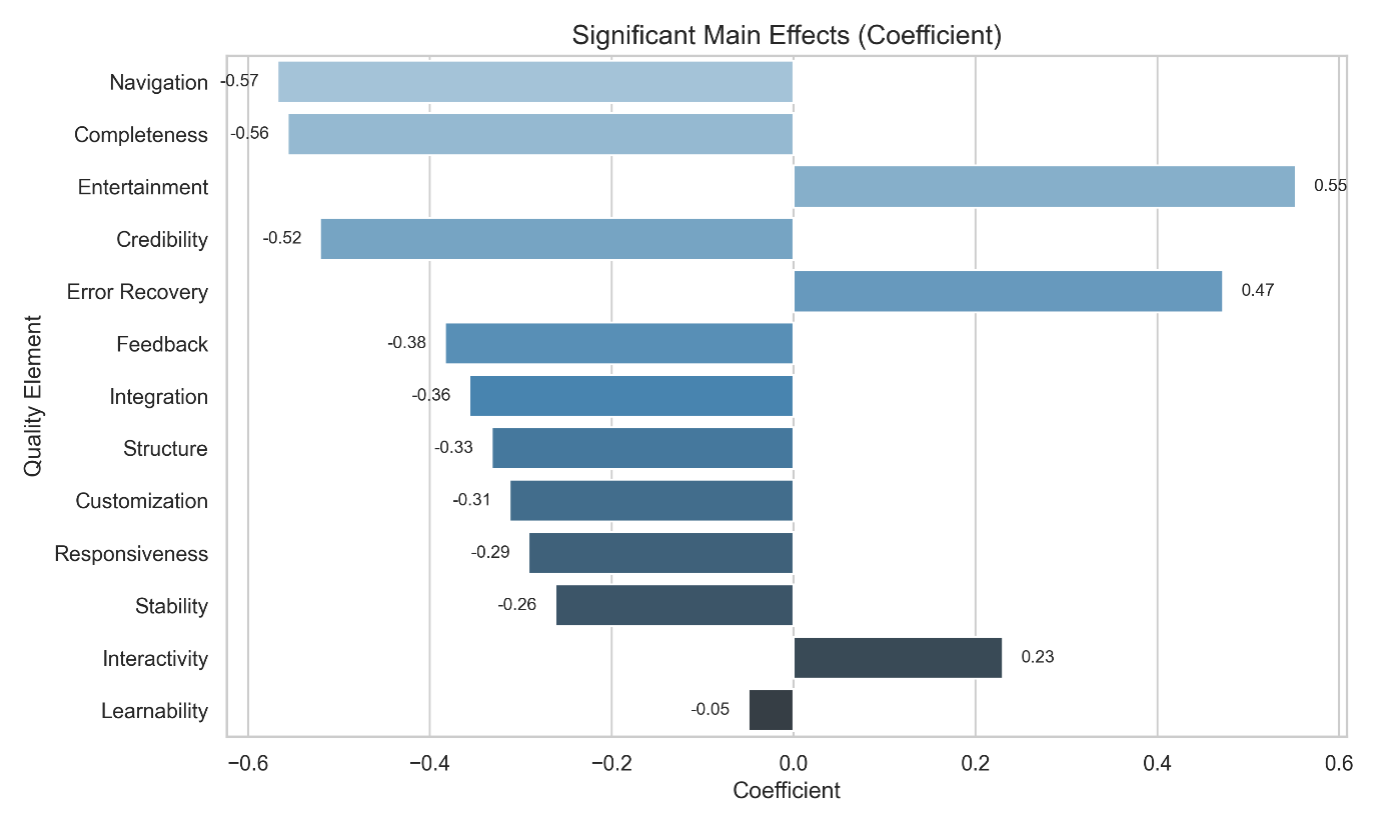
Takeaway: Understanding user experience requires considering both the quality factors users mention and the emotional context of their reviews.
Tools: Python · Pandas · Scikit-learn · Statsmodels · VADER
Tools Used
Python · Pandas · Scikit-learn · Statsmodels · TF-IDF · VADER · Text Mining · Linear Regression · User Review Analysis